Axis 01 — transcriptional core
WUSCHEL and the architecture of the stem cell niche
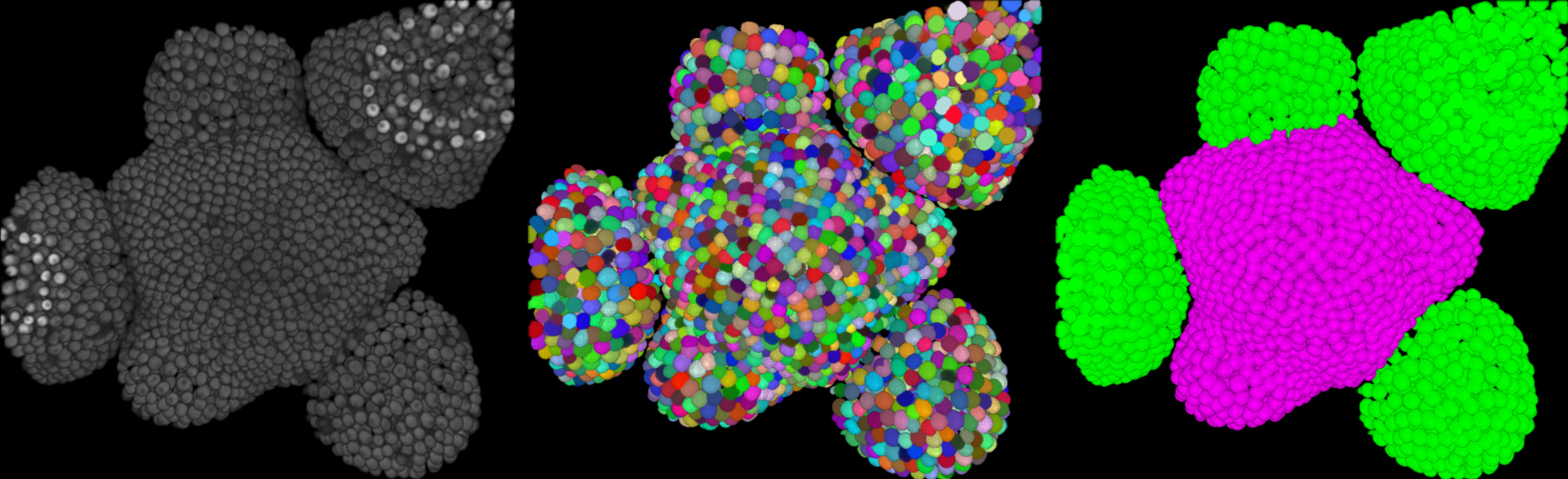
The homeodomain transcription factor WUSCHEL is necessary and sufficient to specify stem cell identity in the shoot apex. We dissect WUS function mechanistically — mapping direct and indirect targets in a cell-type-resolved way, characterising the cofactors and chromatin states it depends on, and asking how a single short-range signal sustains a population of cells across decades of growth.
WUSCHELCLAVATAprotein movementcis-regulation
Foundational publications · Lohmann et al., Cell 2001 · Leibfried et al., Nature 2005 · Busch et al., Dev Cell 2010 · Daum et al., PNAS 2014 · Fuchs et al., bioRxiv 2024
Axis 02 — context-dependent networks
Decoding context-dependent genetic networks in vivo
Which genetic activities are required in each cell of a developing tissue — and how does that requirement shift as the cell’s state and environment change? Through the ERC Synergy project DECODE, with the labs of Boutros, Huber and Stegle, we combine tissue-targeted, conditional CRISPR/Cas9 perturbations with single-cell transcriptomics and live imaging in the Arabidopsis root tip and the Drosophila gut, then infer the direct, cell-state-specific networks that underwrite tissue robustness and plasticity.
conditional CRISPRsingle-cell RNA-seqgene×gene interactionscausal inferencenetwork plasticity
Foundational publications · Gaillochet et al., eLife 2017 · Liu et al., Mol Plant 2021 · Zeng et al., Nat Commun 2023 · Grones et al., Plant Cell 2024 · Wang et al., Nature 2025
Axis 03 — hormonal integration
Cytokinin, auxin and the whole-plant conversation
The stem cell niche does not act alone. Hormonal signals — chiefly cytokinin, auxin and jasmonate — couple meristem behaviour to the developmental, metabolic and defensive state of the whole plant. We map where these pathways intersect the WUS circuit and how their balance is integrated at transcription and at protein turnover, including the trade-off between growth and defence in the shoot apex.
cytokininauxinjasmonategrowth vs. defencesignal integration
Foundational publications · Leibfried et al., Nature 2005 · Zhao et al., Nature 2010 · Schuster et al., Dev Cell 2014 · Gaillochet et al., eLife 2017 · Ma et al., Nat Commun 2019 · Fan et al., bioRxiv 2026
Axis 04 — environment, adaptation & regeneration
Sensing the world: acclimation, regeneration and growth
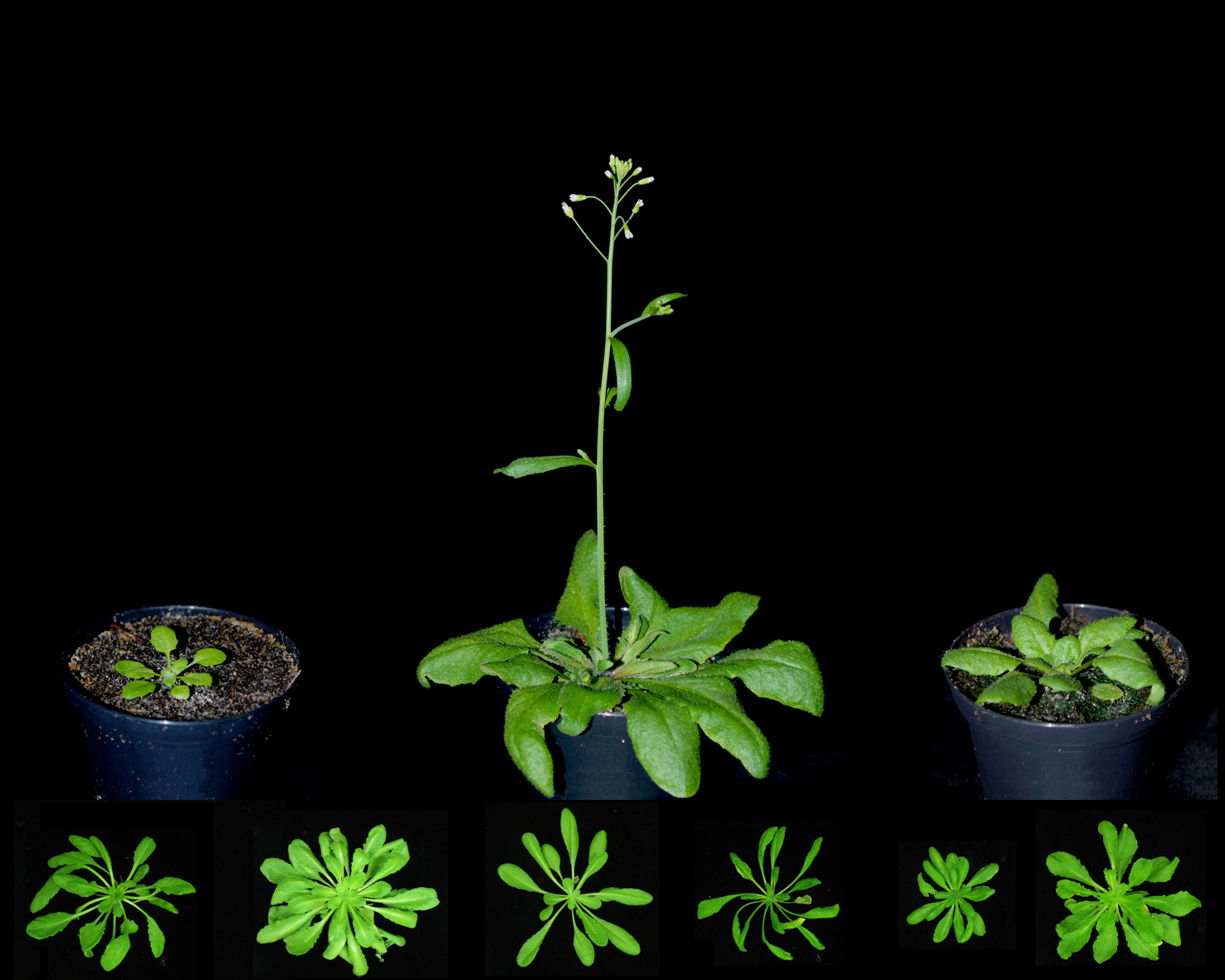
Daylength, temperature, light and nutrients all modulate meristem activity. We ask how the niche senses environmental information, how it meets the metabolic hub of TOR-kinase signalling to set growth, and how short-term acclimation converges with long-term adaptation across natural Arabidopsis variation. The same dimensions govern regeneration: in RegenerateRobust (GreenRobust Cluster of Excellence, with the Marciniak-Czochra and Dagdas labs), we map how temperature and autophagy set its limits across Marchantia, Arabidopsis and Brachypodium.
temperaturelight & sugar signallingnatural variationregenerationautophagycross-species comparison
Foundational publications · Wigge et al., Science 2005 · Pfeiffer et al., eLife 2016 · Pfeiffer et al., Curr Opin Plant Biol 2017 · Janocha et al., bioRxiv 2024 · Baulies et al., Nat Plants 2025